
Why It Matters
Both ants and termites produce winged adults (called alates) whose job is to fly off, pair up and start new colonies. Flying ants are mostly a nuisance. Flying termites in or around your home can mean there's an established termite colony nearby, possibly close enough to reach your house.
Getting the identification right tells you whether to grab the vacuum or book an inspection.
Flying Termites vs Flying Ants at a Glance
| Feature | Flying termite (alate) | Flying ant |
|---|---|---|
| Waist | Thick and straight, with no obvious "waist" | Pinched and narrow, like an hourglass |
| Antennae | Straight, like a string of tiny beads | Bent at an angle ("elbowed") |
| Wings | Two pairs of equal size | Front pair larger than back pair |
| Wing veins | No obvious veins | Strongly veined |
| Wings after landing | Shed quickly, often left in piles | Usually stay attached longer |
Sources: Australian Museum; Kansas State University Entomology.
How to Identify Them Up Close
If you can, trap one under a glass or pick up a dead one and look at it in good light. A phone camera zoom helps.
1. Check the body shape (the waist)
This is the easiest test. An ant has a clearly pinched waist between its middle section and its rear section. A termite's body is much more even, with no narrow waist; it looks thick from front to back.
2. Check the antennae
Ant antennae have a distinct bend, like an elbow. Termite antennae are straight and made of small bead-like segments, so they can look slightly droopy or curved, but never sharply bent.
3. Check the wings
Termites have four wings of equal size that extend well past the end of the body. Ants have four wings too, but the front pair is noticeably bigger than the back pair. The Australian Museum also notes that ant wings are strongly veined, while termite wings have no obvious veins.
4. Look for dropped wings
Termite alates are weak fliers and drop their wings soon after landing. If you find small piles of identical, papery wings on windowsills, under lights or near doors (with few or no insects attached), termites are the likely cause.
When Do Termites Swarm in Melbourne?
Termite swarming (also called a "flight") happens in the warmer months. Victorian Department of Health guidance says alates leave the nest in high humidity and still air, sometimes in low light, and are weak fliers that usually travel up to about 1 km, though wind can carry them further. (Victorian Department of Health)
In Melbourne, Victorian pest controllers commonly report swarming from around October to December, often on warm, humid, still evenings after rain, and sometimes continuing through summer depending on the weather. (Termite Tactics, Melbourne; Termite Solutions Victoria) Different species swarm at different times, so a flight outside this window is possible.
Flying ants also swarm on warm, humid days, which is why the two are so often confused.
Which termites are we talking about?
In Victoria, the genus Coptotermes is the main concern. Victorian Department of Health guidance says it's widespread across the state and responsible for more than 80% of termite damage to buildings, with Coptotermes acinaciformis and Coptotermes frenchi both named. These are subterranean termites: they live in the soil, in tree stumps or in trees, and travel into buildings through hidden mud tunnels.
Found Flying Termites? What to Do Next
- Don't panic. A swarm doesn't automatically mean your house is being eaten. Alates can fly in from a colony in a nearby tree, stump or neighbouring property.
- Collect a sample. Put a few insects or wings in a sealed bag or jar, or take clear photos. This helps a technician confirm the species.
- Note where you found them. Swarming inside the house, especially from a wall, floor or skirting board, is more concerning than a few alates attracted to an outdoor light.
- Don't spray walls or break into timber. Surface sprays won't reach the colony, and disturbing termites in your walls can push them elsewhere in the house.
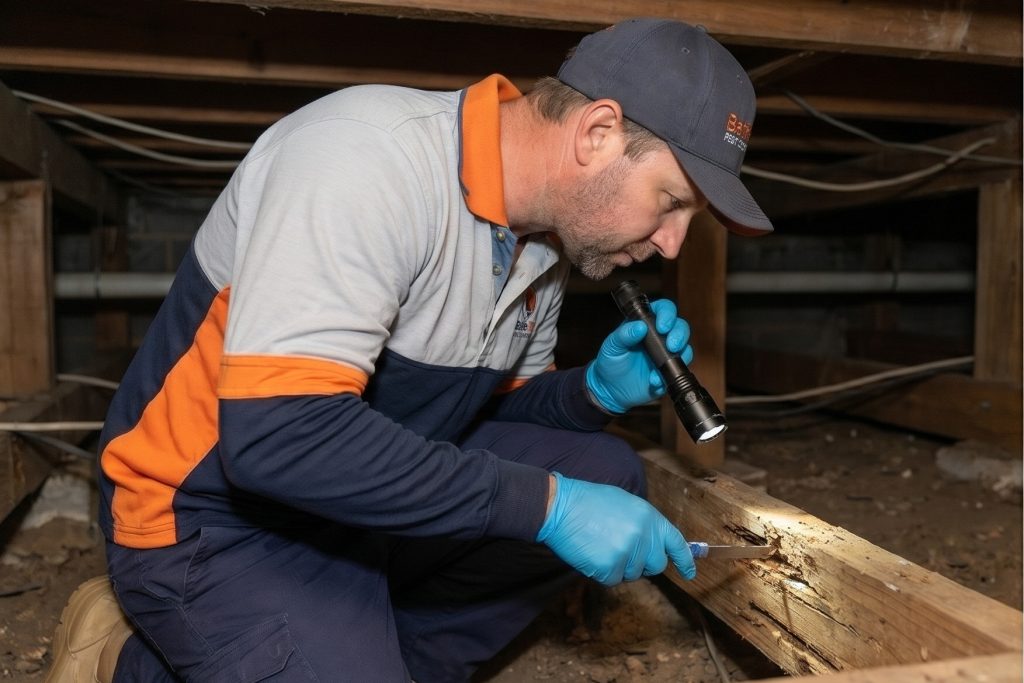
- Book an inspection. A licensed inspector can check the house, subfloor, roof void and garden for active termites and conducive conditions. If termites are found, BattleBugs' inspection report documents the activity and recommended next steps, and we can refer you to a licensed termite treatment specialist.
Seen flying termites around your home? A termite inspection is the fastest way to find out whether they're coming from inside.
And if it's flying ants?
Flying ants are usually a short-lived seasonal nuisance. Vacuum them up, seal gaps around windows and doors, and keep an eye out for ant trails afterwards. If an ant nest keeps causing trouble, see our ant control service.
How to Reduce the Risk of Termites Moving In
- Get an annual termite inspection. Australian Standard AS 3660.2 calls for regular inspections no more than 12 months apart, with more frequent checks in high-risk situations.
- Turn off outdoor lights on swarming nights in spring and early summer. Alates are attracted to light.
- Fix moisture problems. Leaking taps, blocked gutters and poor drainage near the house create the damp conditions termites prefer.
- Keep mulch and garden beds off the walls, and keep weep holes clear. Read Is Mulch a Breeding Ground for Termites?
- Know the other warning signs. See 7 Signs of Termites in Your House.
Frequently Asked Questions
Do flying termites mean I have termites in my house?
What time of year do termites swarm in Melbourne?
Do flying termites eat wood?
Can I just spray flying termites?
Are flying ants harmful?
Not Sure What You've Found?
If you've seen winged insects or piles of wings and you're not sure whether they're ants or termites, BattleBugs can inspect your home and give you a clear answer. Inspections cover the interior, roof void, subfloor, exterior and garden, with a written report.
Or call 03 7045 1085, 24/7.